
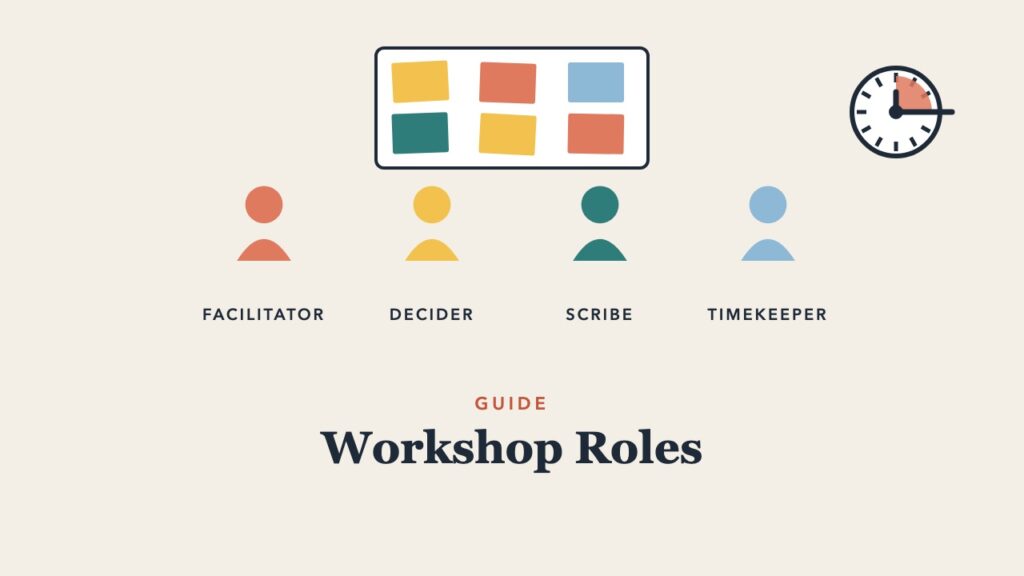
A workshop runs better when everyone knows their job. Who guides the process? Who makes the final call? Who captures what the group decides? This guide explains the most common workshop roles, including facilitator, decider, scribe, timekeeper, and domain expert, what each one does, how roles work in a design sprint, and how to assign them in a small team.
Why Workshop Roles Matter
Without clear roles, the most senior person ends up running the process, deciding, and talking the most, all at once. The group defers, ideas narrow, and the session ends without a clear decision. Assigning roles separates three things that are easy to mix up: guiding the process, contributing content, and making the decision. That separation is what lets a group do its best thinking.
The Core Workshop Roles
Facilitator
The facilitator designs and guides the process. They open the session, explain each activity, keep time, balance participation, and help the group converge on outcomes. A facilitator stays neutral on the content so the group owns the result. In many workshops this is the most important role. See what is facilitation for a full definition.
Decider
The decider has the authority to make the final call when the group cannot reach agreement, or when a decision is needed to move forward. In a design sprint, the decider is usually a senior leader or product owner. A good decider listens first, decides clearly, and explains the reasoning, then supports the decision publicly.
Scribe or recorder
The scribe captures the group’s thinking: ideas, themes, decisions, open questions, and next steps. That might mean writing on a whiteboard, organizing sticky notes on a digital board, or taking structured notes. Good scribes capture the group’s words rather than their own interpretation.
Timekeeper
The timekeeper tracks time for each activity and gives warnings before time runs out. In smaller workshops the facilitator often keeps time, but a separate timekeeper frees the facilitator to focus on the group.
Domain experts
Domain experts bring specialist knowledge about customers, technology, operations, finance, or another area the workshop depends on. They may join for a short “ask the experts” session rather than the whole workshop.
Participants
Participants contribute ideas, experience, and judgment. Their role is to engage fully, build on each other’s ideas, and commit to the outcomes. Some workshops give participants smaller rotating roles such as table host or reporter.
Sponsor
The sponsor is the person or group who asked for the workshop and owns what happens next. The sponsor may open the session to explain why it matters and close it by committing to act on the results.
Producer (for virtual workshops)
In online sessions, a producer manages the technology: admitting people, opening breakout rooms, launching polls, and solving audio problems, so the facilitator can stay with the group.
Workshop Roles at a Glance
| Role | Main job | Who often plays it |
|---|---|---|
| Facilitator | Guide the process and keep it neutral | Trained facilitator, team lead, or outside facilitator |
| Decider | Make the final call | Senior leader, product owner, sponsor |
| Scribe | Capture ideas and decisions | Team member or co-facilitator |
| Timekeeper | Track time and give warnings | Participant or co-facilitator |
| Domain expert | Provide specialist knowledge | Subject matter experts, customers |
| Participant | Contribute and commit | Team members and stakeholders |
| Sponsor | Set the purpose and own follow-through | Executive or program owner |
| Producer | Run the technology online | Event or IT support |
Roles in a Design Sprint
The design sprint, a five-day process for solving a problem and testing a prototype, made several of these roles widely known. A typical sprint team of up to seven people includes a facilitator who runs the process, a decider who makes key choices such as which idea to prototype, and team members representing areas such as design, engineering, marketing, and customer service. Domain experts are interviewed on the first day. Some teams also name a scribe to capture notes and decisions throughout the week.
How to Assign Workshop Roles
- Name the decider before the workshop. Make sure everyone knows who will make the final call and how.
- Keep the facilitator out of the content. If your facilitator also has strong opinions on the topic, consider bringing in a neutral facilitator.
- Combine roles in small groups. With five or six people, the facilitator can keep time and a participant can act as scribe.
- Rotate smaller roles. In longer workshops, rotate scribe and timekeeper so no one is stuck on the sidelines.
- Explain the roles at the start. A one-minute explanation prevents confusion and power struggles later.
Related guides: what is a hackathon and meeting ground rules examples.
Frequently Asked Questions
Can the facilitator also be the decider?
It is possible but risky. When one person both runs the process and makes the decision, participants tend to hold back. If a leader must facilitate, they should say clearly when they are guiding and when they are deciding.
What is the difference between a facilitator and a moderator?
A moderator usually manages a conversation among speakers, such as a panel, while a facilitator designs and guides a whole process for a group to reach an outcome.
How many facilitators does a workshop need?
One facilitator can lead up to about 20 to 25 participants. Larger groups benefit from a co-facilitator or table hosts.
For more on running the session itself, see workshop agenda examples and InnovationTraining.org’s step-by-step guide on how to facilitate a workshop.
