
Disclosure: This post contains affiliate links. If you sign up through them, University Webinars may earn a commission at no extra cost to you.
Should an online course run as a cohort, with a group moving through it together on a schedule, or be self-paced, so learners start anytime and go at their own speed? The answer shapes completion rates, pricing, workload, and the learner experience. This guide compares cohort-based and self-paced courses, explains when each works best, and describes blended models that combine both.
Definitions
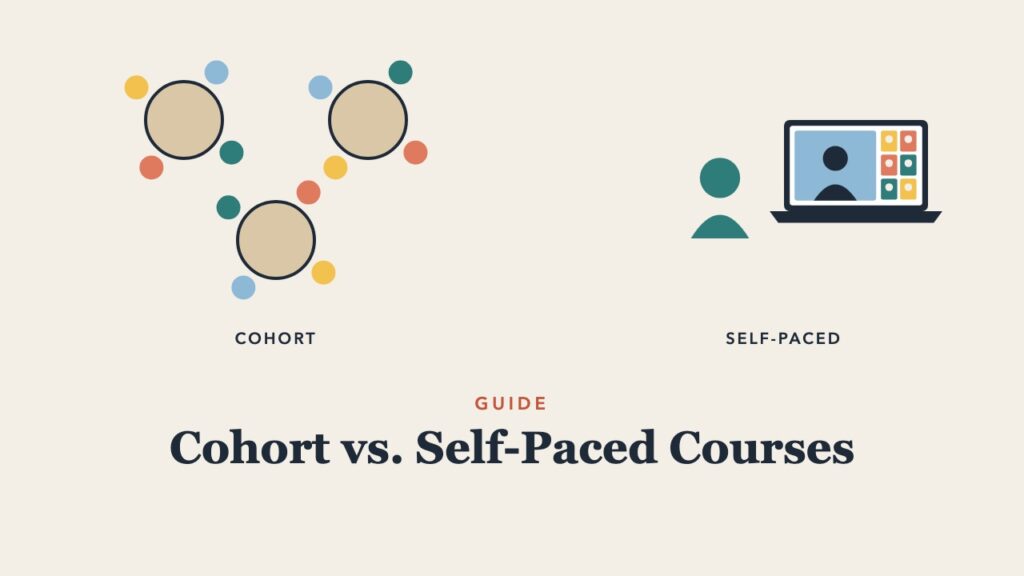
A cohort-based course is an online course where a group of learners starts and finishes together, following a schedule with live sessions, deadlines, and group interaction. A self-paced course is an online course learners can start anytime and complete at their own speed, usually through recorded lessons, readings, and activities.
Comparison Table
| Cohort-based | Self-paced | |
|---|---|---|
| Start date | Fixed | Anytime |
| Schedule | Weekly live sessions and deadlines | Flexible |
| Interaction | High: live sessions, peer groups, feedback | Low to moderate: comments, community, optional support |
| Completion rates | Usually higher | Usually lower |
| Price | Usually higher | Usually lower |
| Instructor time | Ongoing for each cohort | Mostly up front |
| Scale | Limited by group size | Highly scalable |
When to Choose a Cohort-Based Course
- The skill requires practice, feedback, and discussion, such as facilitation, writing, leadership, or design.
- Learners benefit from accountability and peer support.
- You want higher completion and stronger results.
- You can commit time to live sessions and feedback for each group.
- Your audience values community and networking.
When to Choose a Self-Paced Course
- The content is mostly knowledge or step-by-step technical skills.
- Learners have unpredictable schedules or are in many time zones.
- You want a scalable product that does not need your ongoing time.
- The price point needs to be accessible.
- Learners need just-in-time help on specific tasks.
Blended Models
- Self-paced with live office hours. Recorded lessons plus a regular live Q&A.
- Self-paced with optional cohort. A lower-priced self-paced version and a higher-priced cohort with live support.
- Rolling cohorts. Small cohorts start each month, using the same recorded content plus live sessions.
- Evergreen with community. Self-paced content plus an active discussion community.
Many creators start with a cohort to test and refine the content, then record the best material as a self-paced version.
How to Improve Completion in Self-Paced Courses
- Keep lessons short and focused.
- Add a clear schedule suggestion, such as “one module per week.”
- Send progress reminder emails.
- Include quick wins early.
- Offer a community or periodic live session.
- Use a certificate or final project as a finish line.
Platforms for Both Models
Course platforms such as Thinkific and Teachable support self-paced courses and include features for drip scheduling, communities, and live sessions that make cohort-style delivery possible. Check which features are included in each plan.
Frequently Asked Questions
Do cohort-based courses have higher completion rates?
Generally yes. Deadlines, live sessions, and peer accountability help learners finish, which is one reason cohort courses command higher prices.
Can a self-paced course include live sessions?
Yes. Many self-paced courses add optional live office hours or group coaching calls.
Which is easier to create?
A cohort course can launch faster because you can teach live while building. A self-paced course takes more upfront production but less ongoing time.
Related guides: how to outline an online course, how to price an online course, and workshop vs. training vs. course.

