
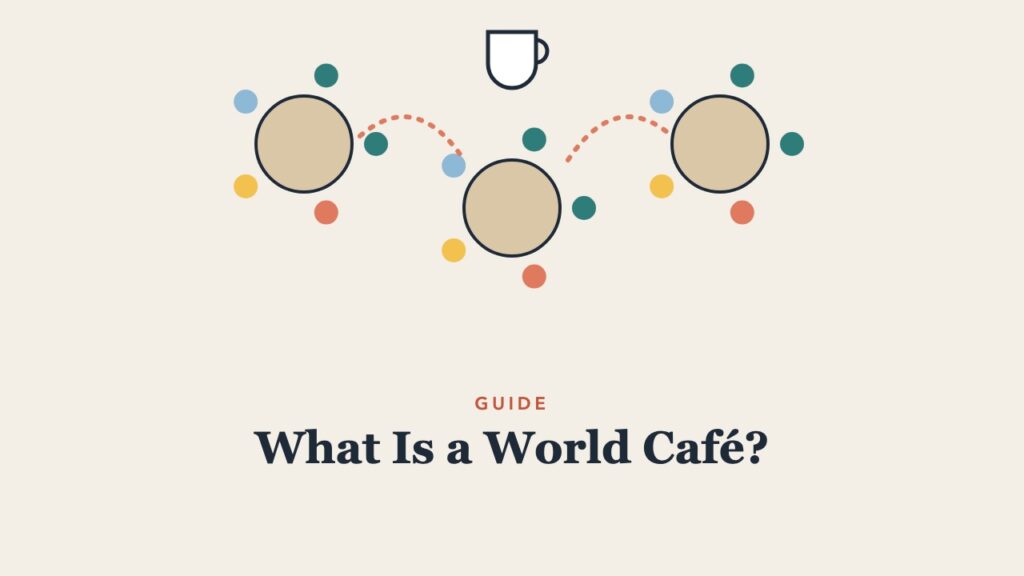
A World Café turns a large group into a series of small café-table conversations, so dozens or even hundreds of people can talk about the questions that matter to them and build on each other’s ideas. It is one of the most widely used large-group discussion methods in organizations, schools, and communities. This guide explains what a World Café is, how it works step by step, and how to host one well.
World Café Definition
A World Café is a structured conversation method in which participants sit at small tables of four or five, discuss a question for about 20 minutes, and then move to new tables for further rounds. One person stays at each table as the host and shares what was said before. After several rounds, the whole group shares themes and insights. The method was developed by Juanita Brown and David Isaacs in the 1990s.
How a World Café Works
- Set the scene. The room looks like a café: small tables, paper tablecloths or flip chart paper, and markers.
- Welcome and introduction. The facilitator explains the purpose, the process, and the etiquette.
- Round 1 (about 20 minutes). Each table discusses the first question. People write and doodle on the paper.
- Move. One table host stays. Everyone else moves to a different table.
- Round 2. The host summarizes the previous conversation, and the new group builds on it, often with a second question.
- Round 3. Another move and another round, often returning to people’s original tables.
- Harvest. The whole group shares the patterns, insights, and questions that came up.
World Café Etiquette
- Focus on what matters
- Contribute your thinking
- Speak your mind and heart
- Listen to understand
- Link and connect ideas
- Listen together for insights and deeper questions
- Play, doodle, and draw on the tablecloth
Sample World Café Agenda (2 Hours)
| Time | Activity |
|---|---|
| 0:00 | Welcome, purpose, and café etiquette |
| 0:15 | Round 1: first question |
| 0:35 | Move tables; Round 2 |
| 0:55 | Move tables; Round 3 |
| 1:15 | Break |
| 1:25 | Whole-group harvest |
| 1:50 | Next steps and close |
Writing Good World Café Questions
The question is the most important design choice. Good café questions are open, relevant to the people in the room, and invite possibility rather than blame. For example:
- “What would it look like if our students felt truly supported in their first year?”
- “What is one change that would make the biggest difference to how we work together?”
- “What are we not talking about that we should be?”
World Café vs. Other Group Methods
| Method | Agenda | Best for |
|---|---|---|
| World Café | Set questions, rotating tables | Exploring a theme with many perspectives |
| Open Space | Participants create sessions | Complex issues with many sub-topics |
| Roundtable | One group, one table | Peer discussion among experts |
| Focus group | Moderator’s questions | Research and feedback |
See what is Open Space Technology and what is a roundtable discussion.
Running a World Café Online
Use breakout rooms as tables and a shared whiteboard or document as the tablecloth. Keep rounds to 15 minutes, assign hosts in advance, and use random reassignment between rounds. See how to run breakout rooms.
Related guides: what is a breakout session, what is an unconference, and check-in and check-out questions.
Frequently Asked Questions
How many people do you need for a World Café?
At least 12, so there are three tables. It works well with hundreds of people if the room has space.
Does a World Café need a facilitator?
Yes. One facilitator explains the process, keeps time, and leads the harvest. Table hosts are participants, not trained facilitators.
What happens to the ideas afterward?
Photograph the tablecloths, collect the harvest notes, and share a summary with participants and decision-makers within a week.

