
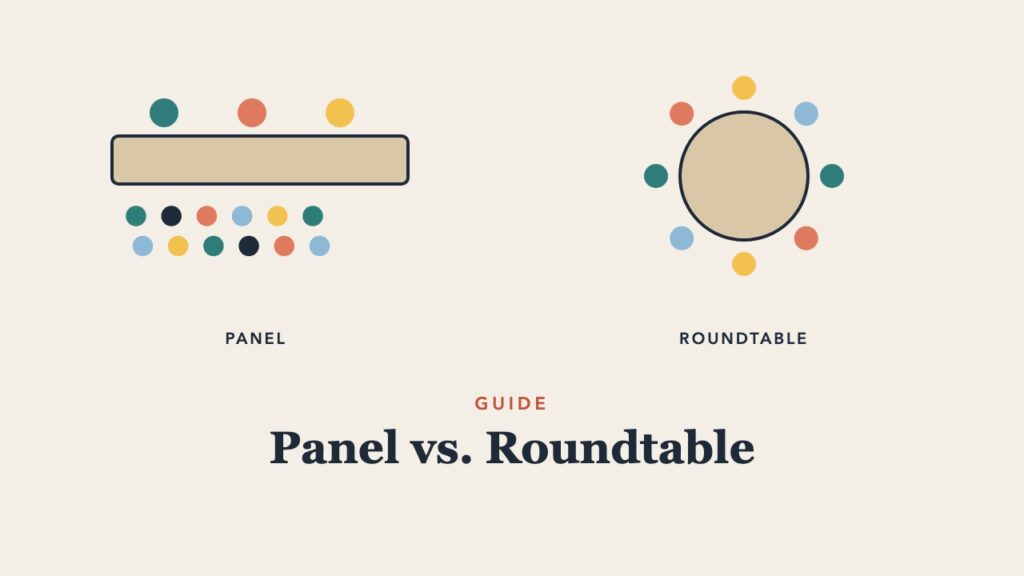
Panels and roundtables both bring several voices together around a topic, and event programs often use the terms loosely. In practice they are different formats with different strengths. A panel is a conversation among experts in front of an audience. A roundtable is a discussion among equals, often with no separate audience at all. This guide compares panel discussions and roundtables and helps you choose the right one.
Panel vs. Roundtable: The Short Answer
A panel discussion features a small group of experts, usually three to five, who discuss a topic and answer questions from a moderator and the audience. A roundtable discussion is a facilitated conversation in which all participants contribute as equals, usually around a table, with no division between speakers and audience.
Comparison Table
| Panel discussion | Roundtable discussion | |
|---|---|---|
| Who speaks | Selected panelists | Everyone at the table |
| Audience | Yes, often large | Usually none, or a small observing group |
| Leader | Moderator | Facilitator or chair |
| Group size | 3 to 5 panelists plus audience | 8 to 20 participants |
| Seating | Panelists on stage facing audience | Around a table or in a circle |
| Goal | Share diverse expert perspectives | Exchange ideas, solve problems, build relationships |
| Outcome | Audience insight | Shared understanding, recommendations, or connections |
When to Choose a Panel
- You want an audience to hear several expert perspectives on one topic.
- The topic benefits from contrast or debate among practitioners.
- You have a large audience and limited time.
- You want to showcase leaders, partners, or community voices.
See what is a panel discussion and these panel moderator questions and tips.
When to Choose a Roundtable
- Everyone in the room has relevant experience to contribute.
- You want peer learning or candid exchange among leaders.
- You need to generate ideas or recommendations on a shared challenge.
- Relationship-building matters as much as content.
See what is a roundtable discussion.
Hybrid Formats
- Panel plus table discussions. A 30-minute panel followed by audience tables discussing the panel’s questions.
- Fishbowl. A small inner circle discusses while others observe. Observers can step in by taking an empty chair.
- Multiple roundtables. A conference session with several tables, each on a different subtopic, with participants choosing a table.
- Fireside chat. A conversation between a host and one guest. See what is a fireside chat.
Tips for Both Formats
- Prepare questions in advance and share the main themes with participants.
- Keep introductions short. Thirty seconds per person is enough.
- Balance voices so no one dominates.
- Close with a synthesis: key takeaways, agreements, or next steps.
Frequently Asked Questions
Is a roundtable more formal than a panel?
Not necessarily. Panels are often more staged because of the audience. Roundtables can be formal, such as a policy roundtable, or informal.
How many people should be on a panel?
Three to four panelists plus a moderator is a good size. Five is the practical maximum for a 45 to 60 minute session.
How many people should be in a roundtable?
Eight to fifteen allows everyone to contribute. Larger groups should split into several tables.

