
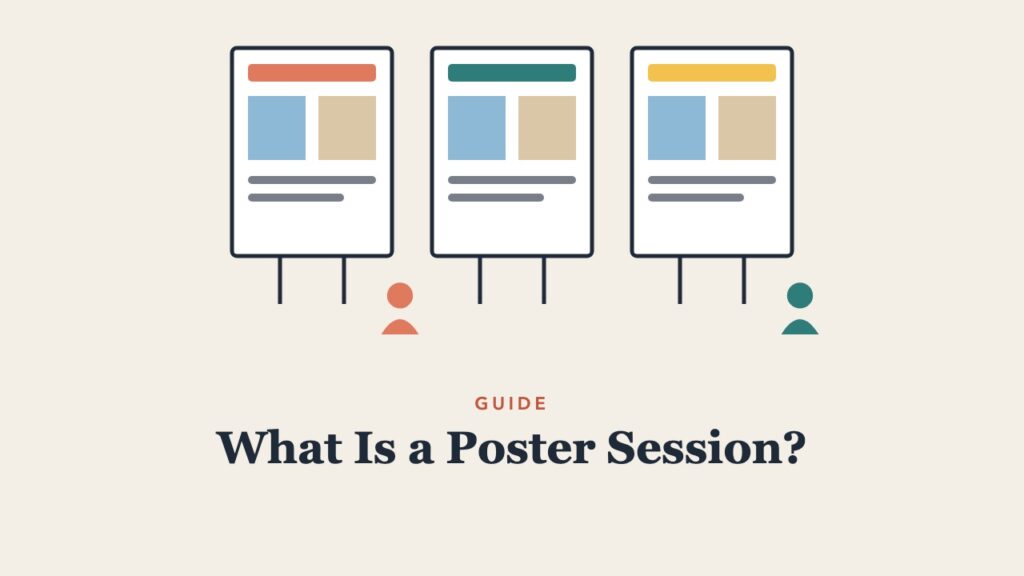
Walk into the large hall at most academic conferences and you will find rows of boards covered in research posters, with presenters standing beside them ready to explain their work. This is a poster session, one of the most common and most useful formats in academic and scientific conferences. This guide explains what a poster session is, how it works, how to make a good research poster, and how to present it.
Poster Session Definition
A poster session is a conference format in which researchers display their work on large printed or digital posters and discuss it one-on-one or in small groups with attendees who walk through the display area. Poster sessions allow many presenters to share work at the same time and encourage conversation and feedback rather than formal presentation.
How a Poster Session Works
- Presenters submit an abstract, which is accepted for poster presentation.
- They prepare a poster, often around A0 size or 36 by 48 inches, following the conference’s guidelines.
- Posters are mounted on boards in a hall, usually grouped by topic.
- During the scheduled session, presenters stand by their posters while attendees browse, read, and ask questions.
- Some conferences include judging, awards, or short “poster pitch” talks.
Poster Session vs. Oral Presentation
| Poster session | Oral presentation | |
|---|---|---|
| Format | Visual display plus conversation | Talk with slides to an audience |
| Audience | Individuals and small groups | A room of attendees |
| Length | Session of 1 to 2 hours; conversations of a few minutes | 10 to 20 minutes plus questions |
| Interaction | High, one-to-one | Limited to Q&A |
| Best for | Detailed feedback, early-stage work, networking | Broad dissemination of findings |
Poster presentations are not lesser than talks. Many researchers get more useful feedback and better connections from a poster session.
What to Include on a Research Poster
- Title, short and readable from a distance
- Authors and affiliations
- Introduction or background: the problem and why it matters
- Research question or objective
- Methods, summarized briefly
- Results, shown mainly through charts, tables, and images
- Conclusions and implications
- References and acknowledgments, in small type
- Contact information or a QR code linking to the paper
Poster Design Tips
- Lead with the main finding. Some designers place the key conclusion in large type at the center of the poster.
- Use fewer words. Aim for a poster that can be understood in about a minute.
- Make text readable from a distance: large title type and body text that can be read from a meter or two away.
- Use a clear reading order, usually columns from left to right.
- Let visuals carry the results. Clear charts beat dense tables.
- Use white space and consistent colors.
How to Present Your Poster
- Prepare a one-minute summary: the question, what you did, what you found, and why it matters.
- Prepare a three-minute version for interested visitors.
- Stand beside the poster, not in front of it, and greet people who stop.
- Ask about their interests to tailor the conversation.
- Bring handouts or a QR code linking to the paper or slides.
- Note feedback and contacts during the session.
Virtual Poster Sessions
Online conferences often host poster sessions using digital posters, short recorded video walkthroughs, and scheduled live video rooms or chat threads for each poster. Some use virtual platforms where attendees move an avatar between posters.
Frequently Asked Questions
How long is a poster session?
Typically one to two hours, often scheduled alongside coffee breaks or receptions.
Is a poster presentation good for a CV?
Yes. Accepted poster presentations are standard academic contributions, especially for students and early-career researchers.
What size is a conference poster?
It varies by conference. Common sizes are A0 or around 36 by 48 inches. Always check the guidelines.
Related guides: what is a conference, what is a symposium, and how to write a conference session proposal.
