
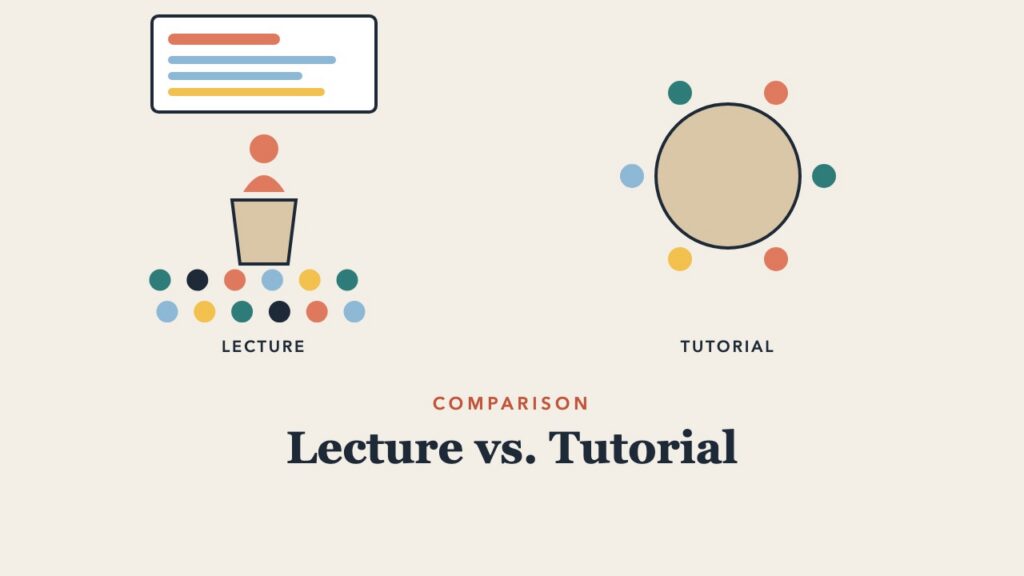
Most university courses combine two kinds of classes: large lectures and small tutorials. They are designed to work together, and students who understand the purpose of each tend to get far more from both. This guide compares lectures and tutorials on size, format, purpose, and what students are expected to do, with tips for each.
The Short Answer
A lecture is a large class where an instructor presents new material to many students at once. A tutorial is a small class where students discuss, practice, and ask questions about that material with a tutor. Lectures deliver the content; tutorials help you understand and apply it.
Lecture vs. Tutorial at a Glance
| Lecture | Tutorial | |
|---|---|---|
| Size | 50 to 500+ students | 5 to 25 students |
| Led by | Lecturer or professor | Tutor, teaching assistant, or lecturer |
| Format | Instructor presents; mostly one-way | Discussion, problems, questions; two-way |
| Student role | Listen, take notes, sometimes respond | Prepare, participate, work through tasks |
| Purpose | Introduce concepts and give an overview | Deepen understanding and practice skills |
| Room | Lecture hall | Classroom or small seminar room |
| Frequency | One to three times a week | Usually once a week |
| Recorded? | Often | Rarely |
| Attendance | Often not checked | Often checked or graded |
How Lectures and Tutorials Work Together
A typical week looks like this: the lecture introduces a topic, students do the reading or problem set, and the tutorial uses that preparation to discuss and apply the ideas. The tutorial is also where misunderstandings show up early, before an exam does it for you. Missing lectures makes tutorials hard to follow; skipping tutorials leaves the lecture content shallow.
Example: One Week in an Economics Course
- Monday lecture (300 students): the professor explains supply and demand curves with examples.
- Before Thursday: students complete five practice problems.
- Thursday tutorial (18 students): the tutor works through the hardest problem, groups solve a new case, and students ask about the parts they found confusing.
Tips for Lectures
- Skim the slides or reading before the lecture so you recognize the key terms.
- Take notes on the structure and examples, not every word, especially if the lecture is recorded.
- Write down questions to bring to the tutorial.
Tips for Tutorials
- Arrive prepared. Tutorials are built on the assumption that you did the work.
- Say something early. It gets easier once you have spoken once.
- Treat mistakes as useful. A tutorial is a safe place to get things wrong before the exam.
Lecture vs. Tutorial vs. Seminar
A seminar is also small and discussion-based, but it is usually a course in its own right, often for advanced students, where participants present and debate ideas. A tutorial supports a lecture course. For more, see lecture vs. seminar.
Frequently Asked Questions
Which is more important, lectures or tutorials?
Both matter, but tutorials are often where understanding is built and where participation counts toward grades. Lectures can sometimes be caught up on through recordings; tutorials cannot.
Do tutorials cover new material?
Usually not. They focus on applying and discussing what was covered in lectures and readings.
What is a lecture and tutorial in university?
They are the two main class types in many courses: lectures for the whole class to hear new content, and tutorials for small groups to work with it.
