
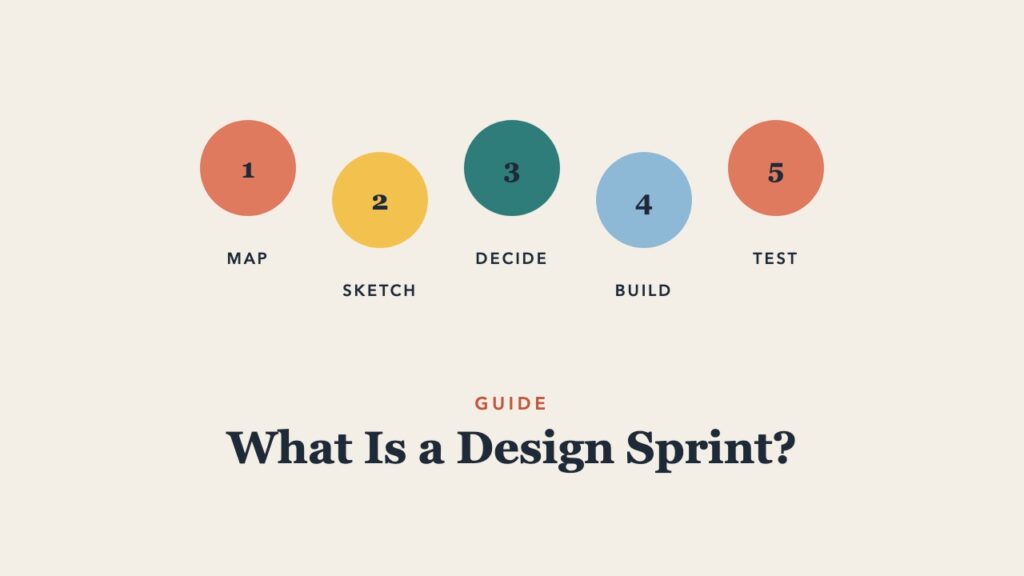
A design sprint compresses months of debate into a few focused days: a small team picks a big problem, sketches solutions, builds a realistic prototype, and tests it with real users before committing time and money. This guide explains what a design sprint is, the five-day structure, who should be in the room, and how it relates to design thinking.
Design Sprint Definition
A design sprint is a time-boxed process, usually five days, in which a cross-functional team works through a critical business question by mapping the problem, sketching solutions, deciding on one, prototyping it, and testing it with users. The method was developed at Google Ventures by Jake Knapp and described in the book Sprint (2016). Many teams now run shorter four-day or remote versions.
The Five Days of a Design Sprint
| Day | Focus | Main activities |
|---|---|---|
| Monday | Map | Set a long-term goal, list sprint questions, map the problem, interview experts, pick a target |
| Tuesday | Sketch | Review existing ideas, then each person sketches a detailed solution alone |
| Wednesday | Decide | Critique sketches, vote, choose the solution, storyboard the prototype |
| Thursday | Prototype | Build a realistic-looking prototype, just enough to test |
| Friday | Test | Five one-on-one interviews with target users; look for patterns |
Who Is on a Sprint Team?
- Decider: the person who can make the final call, such as a product owner or executive.
- Facilitator: runs the process and keeps time.
- Experts: people from product, design, engineering, marketing, customer support, or finance.
Seven people or fewer works best. See workshop roles for more on deciders and facilitators.
Key Design Sprint Techniques
- How Might We notes: reframing problems as opportunities during expert interviews.
- Lightning demos: quick tours of existing ideas from other products or industries.
- Crazy 8s: sketching eight rough ideas in eight minutes.
- Heat map and straw poll voting: silent dot voting to find the strongest ideas without endless debate.
- Five-act interview: a structured format for user testing.
Design Sprint vs. Design Thinking vs. Hackathon
| Design sprint | Design thinking | Hackathon | |
|---|---|---|---|
| What it is | A specific five-day process | A broad, human-centered approach and mindset | A time-boxed building event |
| Length | 4 to 5 days | Hours to months | 1 to 3 days |
| Output | Tested prototype and a decision | Insights, ideas, prototypes | Working builds and demos |
| User testing | Built in on day 5 | Central throughout | Often skipped |
See what is a hackathon.
When to Run a Design Sprint
- The stakes are high and the team is unsure of the right solution.
- A project is stuck in debate.
- You need to test an idea before investing in building it.
Sprints are less useful for small, obvious fixes or for problems that are mainly technical.
Related guides: what is a workshop, workshop agenda examples, and what is a focus group.
Frequently Asked Questions
Can a design sprint be shorter than five days?
Yes. Many teams run a four-day version by combining the map and sketch days. Shorter “mini sprints” of one or two days work for smaller questions.
Can you run a design sprint remotely?
Yes, with a shared online whiteboard, video calls, and shorter daily sessions spread over more days.
Is a design sprint the same as an agile sprint?
No. An agile sprint is a one- to four-week development cycle for building product features. A design sprint is a short process for answering a question before building.
For organizations that want facilitated design thinking or sprint-style sessions, InnovationTraining.org offers design thinking workshops and training.

