When someone reaches out to me about running “a workshop,” the first conversation is usually about what they mean by that word. Some people picture a room full of people building something together. Others picture an expert at the front with slides and a Q&A at the end. Both are valuable, but they are different formats, and picking the wrong one is the fastest way to disappoint a group that showed up expecting the other. This guide explains the difference between a workshop, a seminar, and a webinar, and helps you choose the format that fits what your people actually need.
Workshop vs. Seminar vs. Webinar: The Short Answer
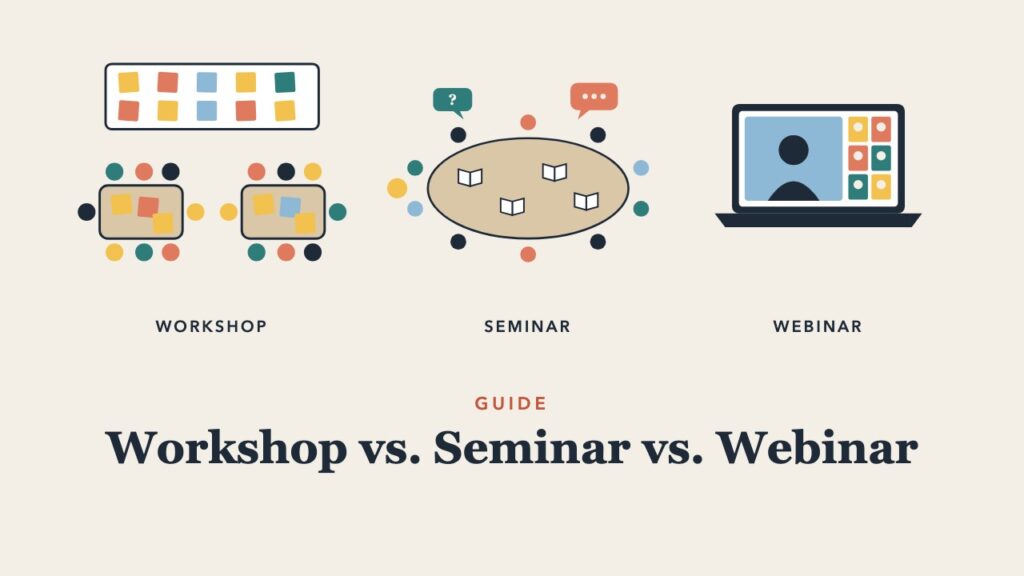
A workshop is a hands-on session where participants actively work on a real challenge and leave with something they created: ideas, a plan, a prototype, or a new skill they practiced. A seminar is a session built around expert input and discussion, where participants mainly listen, ask questions, and talk through ideas. A webinar is a seminar delivered online, usually one or a few presenters speaking to a larger audience with limited interaction through chat, polls, and Q&A.
The simplest way to tell them apart is to ask who does most of the work. In a seminar or webinar, the presenter does most of the thinking out loud. In a workshop, the participants do.
Comparison Table: Workshop, Seminar, and Webinar
| Workshop | Seminar | Webinar | |
|---|---|---|---|
| Main purpose | Build skills, solve a problem, or create something together | Share expertise and discuss ideas | Share information with a large or distributed audience |
| Participant role | Active: doing, making, deciding | Listening, questioning, discussing | Mostly listening, some chat and polls |
| Leader role | Facilitator who designs and guides activities | Expert, instructor, or discussion leader | Presenter, often with a moderator |
| Typical group size | 8 to 40 (larger with small-group tables) | 10 to 100+ (academic seminars are often under 20) | 20 to thousands |
| Typical length | 90 minutes to multiple days | 1 hour to a full day | 30 to 90 minutes |
| Setting | In person or a well-designed virtual room | Classroom, conference room, event venue | Online platform |
| What people leave with | A tangible output and practiced skills | New knowledge and perspectives | Awareness of a topic, often a recording |
| Best for | Innovation, strategy, team challenges, skill practice | Deepening understanding of a subject | Reach, efficiency, and introducing a topic |
What Is a Workshop?
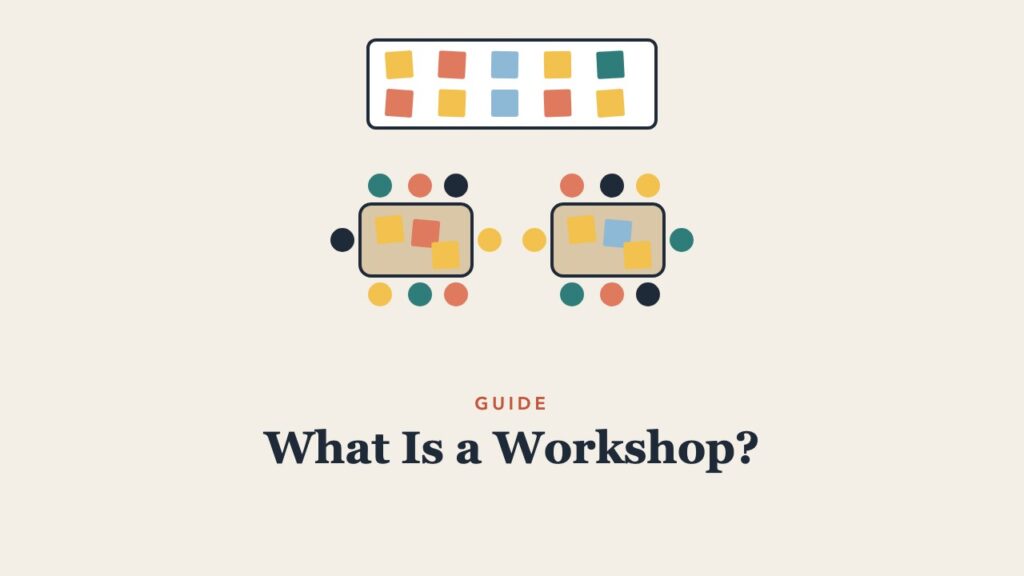
A workshop is an interactive session where a group works through a real challenge using structured activities led by a facilitator. The word comes from the physical workshop where craftspeople made things, and the modern meaning keeps that idea of making. A good workshop has a clear purpose, a sequence of activities that move people from exploring to deciding, and an output the group can use after the session ends. Design thinking workshops, brainstorming sessions, strategy offsites, and skills trainings built around practice all fall into this category.
For a full definition, common types, and a step-by-step design process, see What Is a Workshop? Definition, Examples, and How to Design One.
What Is a Seminar?
A seminar is a session where a knowledgeable leader shares ideas and guides discussion on a focused topic. The word has two flavors depending on where you hear it. In universities, a seminar is a small, discussion-based course or meeting where students or scholars come prepared with readings and talk through them together, often with someone presenting their work. In professional settings, a seminar usually means an expert-led event, like a half-day seminar on employment law or a leadership seminar at a conference, where the audience listens and asks questions.
Both versions center on knowledge and conversation more than on producing something. I cover the definition, types, and ways to make seminars more engaging in What Is a Seminar? Definition, Format, and Examples.
What Is a Webinar?
A webinar (web plus seminar) is a live or recorded online presentation delivered to an audience that joins remotely. Webinars are efficient. You can reach hundreds of people across time zones without anyone getting on a plane, and the recording keeps working for months. That same scale is why most webinars stay close to one-way delivery, with interaction limited to the chat box, a few polls, and questions at the end. Much of the archive on this site started as exactly that kind of university and professional webinar.
One distinction worth making: a webinar and a virtual workshop are different things, even though both happen on Zoom. A virtual workshop uses breakout rooms, digital whiteboards, and hands-on activities so participants do real work together online. If your goal is collaboration, calling it a webinar sets the wrong expectation. I’ve written more about designing interactive online sessions in this virtual workshop and retreat series.
The Real Difference: Presenting vs. Facilitating
Early in my career I thought my job was to present well. I designed talks, built slides, brought the energy, and hoped people would learn something. Then graduate school research on how people learn challenged that model, because adults learn best when they are actively engaged, talking with each other, and working on something real. That research is the whole argument for workshops. I wrote about that change in From Presenter to Facilitator: The Shift That Changed My Work.
So when you are deciding between a seminar and a workshop, the format question is really a question about your role. A seminar asks you to prepare great content. A workshop asks you to design an experience and trust the group process. Those are different skills, and it is very common for experts who give excellent seminars to struggle the first time they facilitate a workshop.
How to Choose: Workshop, Seminar, or Webinar?
Start with the outcome, not the format. These questions will usually point you to the right answer:
- What should people leave with? If the answer is understanding or awareness, a seminar or webinar works well. If the answer is a decision, a plan, a set of ideas, or a skill they can actually use, run a workshop.
- How many people are coming? A group of 500 is a webinar or a keynote. A group of 25 can do real work together. Large groups can still get workshop elements if you break them into tables with a clear activity.
- Do participants already share a challenge? A team, department, or cohort working on the same problem is ideal for a workshop. An open audience with varied goals often gets more from a seminar.
- How much time do you have? In 45 minutes you can run a strong seminar or a short interactive activity. Most meaningful workshops need at least 90 minutes.
- Where will it happen? In person favors workshops. Online can support either, as long as you design for it.
Many of the best sessions are hybrids. A seminar with a 20-minute application activity in the middle, or a workshop that opens with a short expert input, gives people both the knowledge and the chance to use it.
Three Examples of Each Format
A workshop: identifying the real challenge
A university student affairs division wants to improve first-year student retention. Instead of a presentation on retention research, a facilitator runs a three-hour workshop. Staff review student stories and data in small groups, map where students struggle, reframe the problem as “How might we…” questions, brainstorm ideas, and vote on two concepts to prototype over the next month. The group leaves with a shared definition of the challenge and a short list of experiments they own. That flow follows the design thinking workshop process.
A seminar: the lunchtime expert session
A research center hosts a monthly lunchtime seminar. A faculty member presents 30 minutes of new findings on hybrid work and wellbeing, then the moderator opens 25 minutes of discussion with the 20 people around the table. Nobody produces anything, and that is fine. The goal is exposure to current thinking and a good conversation among colleagues from different departments.
A webinar: training at scale
A professional association needs to explain a new certification requirement to 800 members across the country. A 60-minute webinar covers the changes, uses two polls to check understanding, answers the most common questions from the chat, and is recorded for anyone who could not attend. A workshop would be the wrong tool here. The need is clear information delivered efficiently.
How to Turn a Seminar Into a Workshop
The most common upgrade I help people make is taking a content-heavy seminar and turning it into a workshop. A few moves make most of the difference:
- Cut the content in half. This is the painful part. Keep only what participants need in order to do the activities.
- Define the output. Decide what the group will create by the end: a list of prioritized ideas, an action plan, a draft, a prototype.
- Add an activity every 10 to 15 minutes. Pair discussions, sticky-note brainstorming, gallery walks, and quick sketches all work. The rules for brainstorming are a good place to start.
- Switch your role from presenter to facilitator. Ask questions, set up activities, watch the room, and help groups converge.
- Close with reflection. Give people time to make meaning of what they created and what it means for their work.
If you want to build this skill with a group, the facilitation workshop at InnovationTraining.org is designed for leaders and subject matter experts making this move.
Video: Workshop vs. Seminar
This short video from AJ&Smart, a workshop design firm, walks through the difference from their perspective. It was the original resource on this page and is still a helpful quick watch.
Frequently Asked Questions
Is a workshop more interactive than a seminar?
Yes. Interaction is the defining feature of a workshop, since participants spend most of the time doing activities. Seminars include discussion and questions, but the expert’s input carries most of the session.
Can a webinar be a workshop?
An online session can be a workshop if participants do real work together through breakout rooms, whiteboards, and structured activities. At that point it is better described as a virtual workshop than a webinar.
What is the difference between a seminar and a conference?
A conference is a larger event made up of many sessions, which may include keynotes, seminars, panels, and workshops. A seminar is a single focused session.
What is the difference between a workshop and a training?
Training is the goal of building a skill. It can be delivered as a seminar, a webinar, an online course, or a workshop. Training delivered as a workshop is usually the most effective for skills that require practice.
Related Guides
- What Is a Workshop? Definition, Examples, and How to Design One
- What Is a Seminar? Definition, Format, and Examples
- Workshop vs. Training vs. Course
- Webinar vs. Webcast vs. Virtual Event
- What Is a Lecture?
- Workshop Agenda Examples
What is one session on your calendar right now that is planned as a seminar but would do more good as a workshop? If you want personal help designing it, my Innovative Workshop Design and Facilitation Coaching program walks you through building a workshop you can run with confidence.