
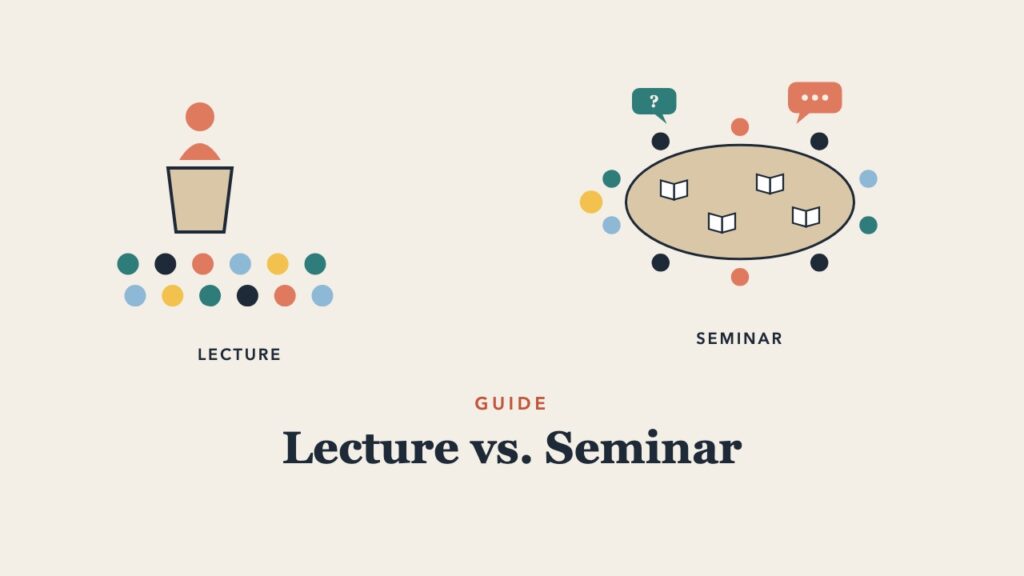
Lectures and seminars are the two most common class formats at universities, and many courses combine them. A lecture is where an expert explains material to a large group. A seminar is where a smaller group discusses and works with that material. This guide explains the difference between a lecture and a seminar, what each expects of students, and how to get the most out of both.
Lecture vs. Seminar: The Short Answer
A lecture is a presentation by an instructor to a group, often a large one, with students mainly listening and taking notes. A seminar is a smaller class where students discuss readings, present ideas, and analyze problems together, guided by an instructor or tutor. Lectures deliver knowledge. Seminars help students test, apply, and deepen it.
Comparison Table
| Lecture | Seminar | |
|---|---|---|
| Group size | Often 50 to several hundred | Usually 8 to 25 |
| Who talks most | The lecturer | The students |
| Student role | Listen, take notes, ask occasional questions | Prepare, discuss, present, and debate |
| Preparation | Helpful but not always required | Essential, usually readings or tasks |
| Room | Lecture hall with rows of seats | Classroom with seats around a table |
| Assessment | Usually through exams and assignments | Often includes participation and presentations |
| Goal | Introduce and explain content | Analyze, apply, and question content |
What Is a Lecture?
A lecture is a structured talk in which an expert explains a topic, often with slides and examples. Lectures are efficient for introducing frameworks, theories, and large amounts of information to many students at once. Many universities record lectures so students can review them. See what is a lecture for types and examples.
What Is a Seminar?
A seminar is a small-group class built around discussion. Students come having read or prepared something, and the session is spent questioning, interpreting, and connecting ideas. Seminars are common in the humanities and social sciences, in upper-level courses, and in graduate programs. See what is a seminar for a full guide.
How Lectures and Seminars Work Together
Many university courses pair a weekly lecture with a weekly seminar or tutorial. The lecture introduces the week’s topic to the whole class. The seminar breaks students into small groups to discuss the readings and apply the lecture’s ideas. In this model, the lecture provides the map and the seminar is where students learn to navigate.
Lecture vs. Seminar vs. Tutorial
In some university systems, especially in the United Kingdom and Australia, a tutorial is a small-group session similar to a seminar, sometimes with even fewer students and a stronger focus on problem-solving or individual feedback. In the United States, “discussion section” or “recitation” often describes the small-group session attached to a large lecture course.
How to Succeed in Lectures
- Skim the reading or slides beforehand so the lecture is your second exposure, not your first.
- Take notes in your own words, focusing on structure and examples rather than every sentence.
- Write down questions as they occur, and ask them during Q&A or office hours.
- Review your notes within a day to fix the ideas in memory.
How to Succeed in Seminars
- Do the reading and note two or three points you agree with, disagree with, or do not understand.
- Speak early. Your first contribution is the hardest, so make it in the first ten minutes.
- Build on others’ points: “I agree with Sam, and I would add…”
- Ask genuine questions. Seminars reward curiosity as much as answers.
- Listen as carefully as you speak.
Making Lectures More Interactive
The line between lectures and seminars is blurring as instructors add discussion, polls, and short activities to large classes. Even in a lecture hall of 200, a two-minute “turn to your neighbor” question changes the experience. For practical techniques, see how to turn a lecture or webinar into an interactive session.
Frequently Asked Questions
Is a seminar harder than a lecture?
Seminars ask more of students during class because you must prepare and participate. Many students find them more rewarding for the same reason.
Do I have to speak in a seminar?
Usually yes. Participation is often part of the grade. Preparing one question or comment in advance makes it easier.
Are lectures still useful?
Yes. A clear lecture is an efficient way to introduce complex material, especially when it includes examples and short moments of interaction.
What is the difference between a seminar and a workshop?
A seminar centers on discussion and analysis. A workshop centers on hands-on practice. See workshop vs. seminar.
