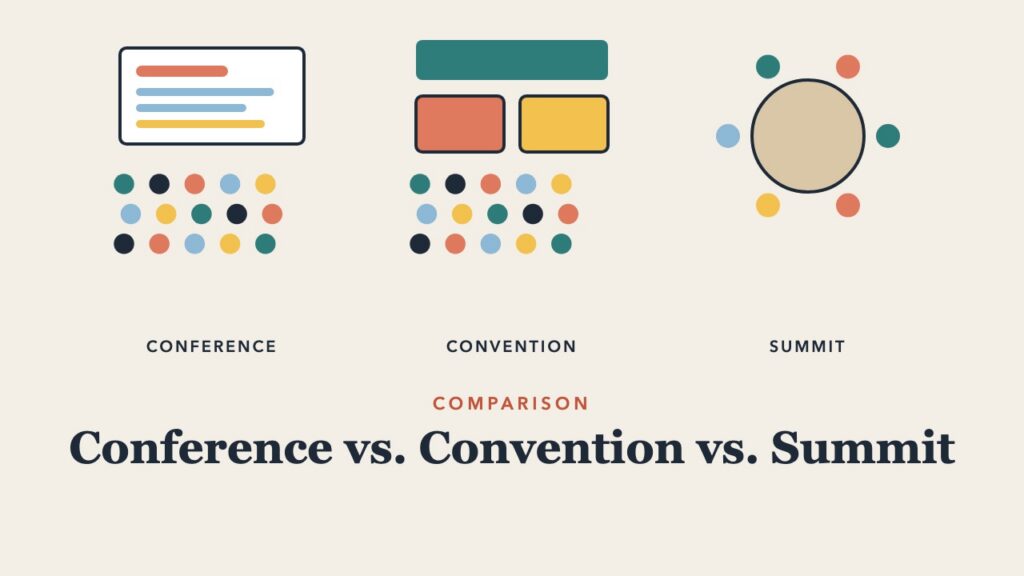
Event organizers use “conference,” “convention,” and “summit” loosely, and sometimes interchangeably. They do carry different expectations about size, audience, and purpose. Choosing the right word helps attendees know what kind of event they are signing up for. This guide compares the three side by side, with examples and a quick way to choose.
The Short Answer
- A conference brings people together to learn and share ideas on a topic or field.
- A convention brings members of a group together, usually at large scale, often with official business such as votes.
- A summit brings senior leaders or experts together to discuss a major issue and reach agreements or set direction.
Side-by-Side Comparison
| Conference | Convention | Summit | |
|---|---|---|---|
| Organized around | A topic or field | A membership or shared interest | A big issue or decision |
| Typical size | 50 to several thousand | Thousands | A dozen to a few hundred |
| Who attends | Practitioners, researchers, anyone interested | Members, fans, delegates | Leaders, decision-makers, invited experts |
| Main activities | Talks, panels, papers, workshops | General sessions, breakouts, exhibit hall, business meeting | Discussions, working sessions, statements |
| Exhibit hall | Sometimes | Usually | Rarely |
| Expected outcome | Learning and connections | Community, learning, decisions by members | Agreement, commitments, a shared plan |
| Tone | Professional or academic | Festive and large | High-level and focused |
Examples
- Conference: an annual research conference in education technology, with paper presentations and poster sessions.
- Convention: a national association of teachers holding its annual gathering, with thousands of members, an exhibit floor, and a delegate assembly; or a comic and pop culture convention.
- Summit: a meeting of heads of state, or a company bringing its top 50 leaders together to agree on next year’s strategy.
Where the Lines Blur
Marketing often stretches the words. Many online “summits” are really a series of recorded interviews, which is closer to a virtual conference. Many associations call their annual convention a conference, and vice versa. Some technology companies call large customer conferences “summits” to sound exclusive. Attendees should read the agenda rather than rely on the name.
How to Choose the Right Name for Your Event
- If the point is learning on a theme, and anyone interested can attend, call it a conference.
- If the point is your members gathering at scale, with an exhibit hall or official business, call it a convention.
- If a smaller group of senior people will work toward a decision or shared commitment, call it a summit.
- If it is a single day of short talks, consider “forum,” “symposium,” or simply “event.” See conference vs. seminar vs. symposium and what is a forum.
Related Terms
- Congress: common outside the US for large international scientific or medical meetings; similar to a conference or convention.
- Expo or trade show: the exhibit floor is the main event.
- Symposium: a smaller academic meeting with several experts on one topic.
- Unconference: attendees set the agenda on the day.
Frequently Asked Questions
Is a summit bigger than a conference?
Usually not. A summit is typically smaller and more senior than a conference. The word refers to the level of the people involved, not the size of the event.
Is a convention the same as a conference?
They overlap. A convention is usually larger and tied to a membership organization, while a conference is tied to a topic. Many events could reasonably use either name.
What is a summit meeting in business?
A summit in business is a meeting of senior leaders, from one company or several, to align on strategy, solve a major problem, or agree on a joint plan.