
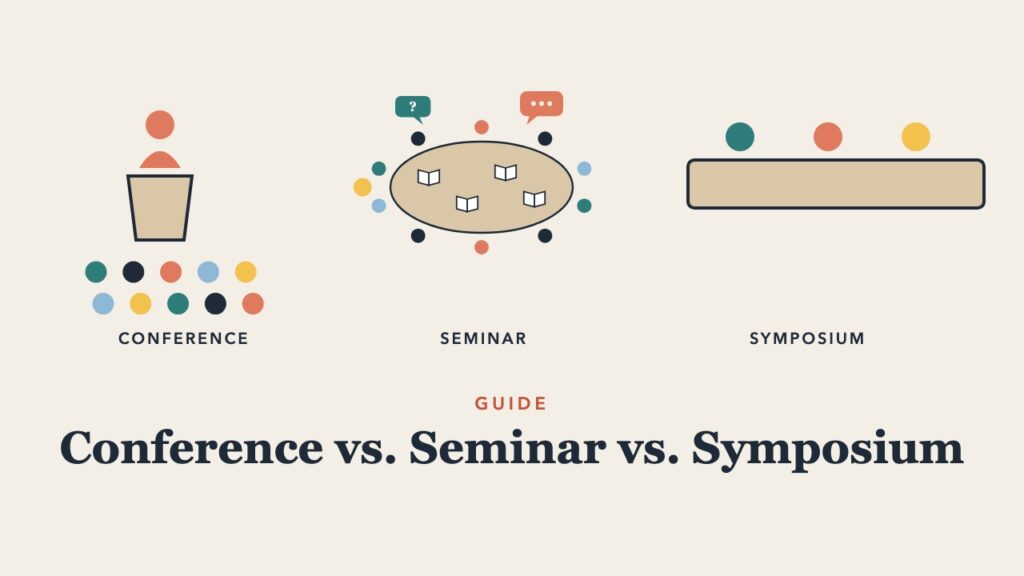
Conference, seminar, symposium, convention, colloquium: event names get used loosely, and the same kind of event can carry a different label at a university than in a professional association. This guide compares the most common formats side by side so you can tell them apart, choose the right name for your own event, and know what to expect when you attend one.
The Short Answer
- A conference is a larger event, usually one to three days, with many sessions and speakers on a broad theme or field.
- A seminar is a single, focused session or course on one topic, usually with a small group and a lot of discussion.
- A symposium is a smaller, more formal event where several experts present different perspectives on one topic, followed by discussion.
In other words, a conference is broad, a seminar is deep and conversational, and a symposium is one topic seen through several expert lenses.
Comparison Table
| Conference | Seminar | Symposium | |
|---|---|---|---|
| Scope | A whole field or broad theme | One specific topic | One topic, several expert views |
| Size | Dozens to thousands | Usually 5 to 30 people | Usually 20 to 200 people |
| Length | One to several days | One to three hours, or a semester-long course | Half a day to two days |
| Structure | Keynotes, parallel breakouts, panels, workshops, networking | A leader guides discussion of readings or a presentation | A series of expert talks with moderated discussion |
| Participation | Varies by session | High, discussion is the point | Moderate, mostly in Q&A |
| Typical setting | Professional associations, industries, academic fields | Universities and professional development | Universities, research centers, medical and legal fields |
Conference vs. Seminar
The clearest difference is scale. A conference contains many sessions, and a seminar is one session (or a recurring course). In fact, many conferences include seminar-style sessions inside them. A conference is the place to survey a field and meet many people. A seminar is the place to go deep on one topic with a small group and talk it through. Read more in what is a seminar.
Conference vs. Symposium
A symposium is narrower and usually more formal than a conference. Instead of dozens of parallel sessions, a symposium typically has one track: a sequence of invited experts who each address the same topic from a different angle, followed by discussion. Universities often host a symposium to mark an anniversary or explore an emerging issue, while a conference serves an entire field every year. See what is a symposium.
Seminar vs. Symposium
Both focus on a single topic, but a seminar centers on discussion within a small group, while a symposium centers on presentations from several experts to a larger audience. If participants are expected to have read something and talk about it, it is a seminar. If they are coming to hear a lineup of experts, it is a symposium.
Other Event Formats You Will See
- Convention. A large gathering of members of an association, industry, or community, often with business meetings, exhibits, and social events alongside sessions.
- Summit. A high-level meeting of leaders or experts focused on a shared challenge, often shorter and more selective than a conference.
- Colloquium. An academic talk or series where a scholar presents work to a department, followed by questions. See what is a colloquium.
- Workshop. A hands-on session where participants practice, create, or solve something together. See workshop vs. seminar.
- Forum. An event or session built around open discussion of an issue, often with audience participation.
- Webinar. An online seminar or presentation. See what is a webinar.
How to Choose the Right Name for Your Event
- Many sessions, many speakers, a broad audience: call it a conference.
- One topic, a small group, and real discussion: call it a seminar.
- One topic with several invited experts presenting: call it a symposium.
- Participants will build, practice, or decide something: call it a workshop.
- Leaders gathering to tackle a shared challenge: call it a summit.
The name sets expectations. People who sign up for a workshop expect to participate, and people who sign up for a symposium expect to listen to experts. Choosing the right label helps the right people show up ready for the right experience.
Frequently Asked Questions
Is a symposium bigger than a conference?
Usually not. A symposium is typically smaller and more focused than a conference, with one track of invited speakers on a single topic.
Can a seminar be part of a conference?
Yes. Many conferences include seminar-style sessions, especially smaller breakouts built around discussion of one topic.
What is the difference between a conference and a convention?
The terms overlap. A convention is usually a large membership or industry gathering that includes business meetings, exhibits, and social events, while a conference emphasizes educational sessions and the exchange of ideas.
Which format is best for learning?
It depends on the goal. Conferences are best for breadth and connections, seminars for deep understanding through discussion, and workshops for building skills through practice.
Designing a session for one of these formats and want people to take part rather than only listen? See InnovationTraining.org’s guide to how to facilitate a workshop.
